So I know I’ve been missing for quite some time now. Before my time in Morocco comes to a close, I wanted to share some pictures of my travels featuring Moroccan monuments, fellow study abroad-ers and of course a few four-legged companions. Not to worry! I should be back blogging soon. Right now I am focusing on my big story (like any well-respecting journalist).
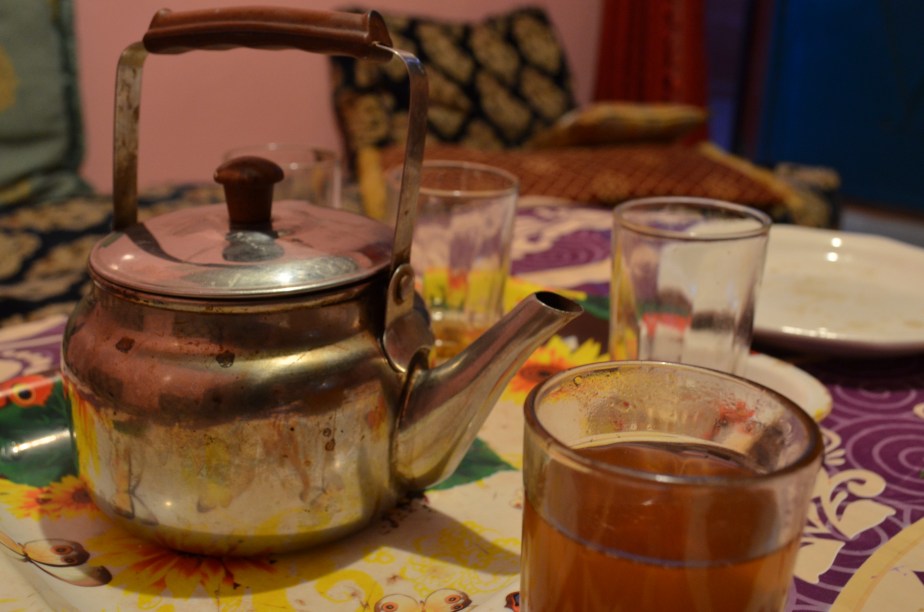
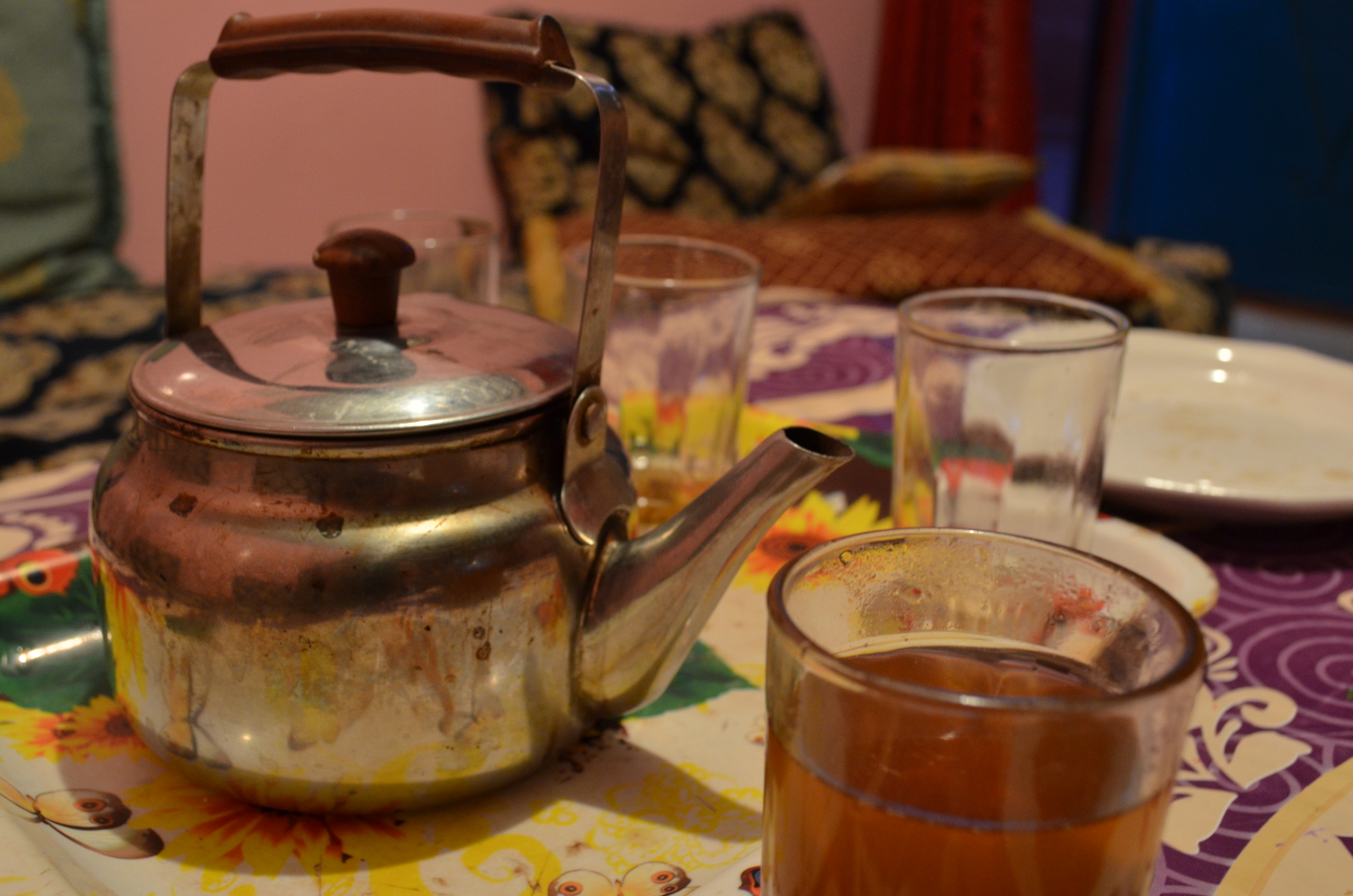
Mint tea is a daily break from my afternoon crunch. And a chance for me to get my sugar fix. Three giant cubes in this pot!
Those of you who know me well are probably aware that anxiety is my middle name. The Vikings would have dubbed me Liz the Worrier, and I would ironically die in almost every horror movie. My fear creeps in at the very insinuation of the word deadline.
You may be thinking, “…and this girl wants to be a journalist?”
Short answer: Yes. What could be more life-affirming than facing an all-consuming fear everyday? What could be better than learning to let go?
Mastering this craft has the added element of conquering my anxiety on almost every project I do. I’ve tried yoga, running, deep breathing exercises and of course, trying to ignore it. No matter what i do, or how small the project, I hate the feeling I get when a story is out of my immediate control. I will pace for the greater part of a half hour waiting for a source to reply to my emails and my eyes will always dart to the nearest clock when I hit a dead end in my research.
So here I am with my first assignment…in a foreign country…in another’s home. I’m tapping my fingers. I’m sighing. I’m pacing and furiously typing.
My sister is worried.
“Labez?” -“Jayeed” -“You should take a nap.” -“Shokran. But I’m not tired.”
But in a Moroccan household there is one occasion that I am forced to break for. Food. “Maj, Liz maj!”
So on Saturday, between scanning for articles and brainstorming interview subjects, I walked upstairs and peeked my head into the kitchen where Mama and Papa sat. Moma preparing for tea. Papa gazing past her out the window and smoking.
At this point, I think my family has realized that I like to help cook. When she saw me, Mama clamped down on my arms and pulled me over to the counter. She put a bowl of egg in front of me and dropped a fork inside.
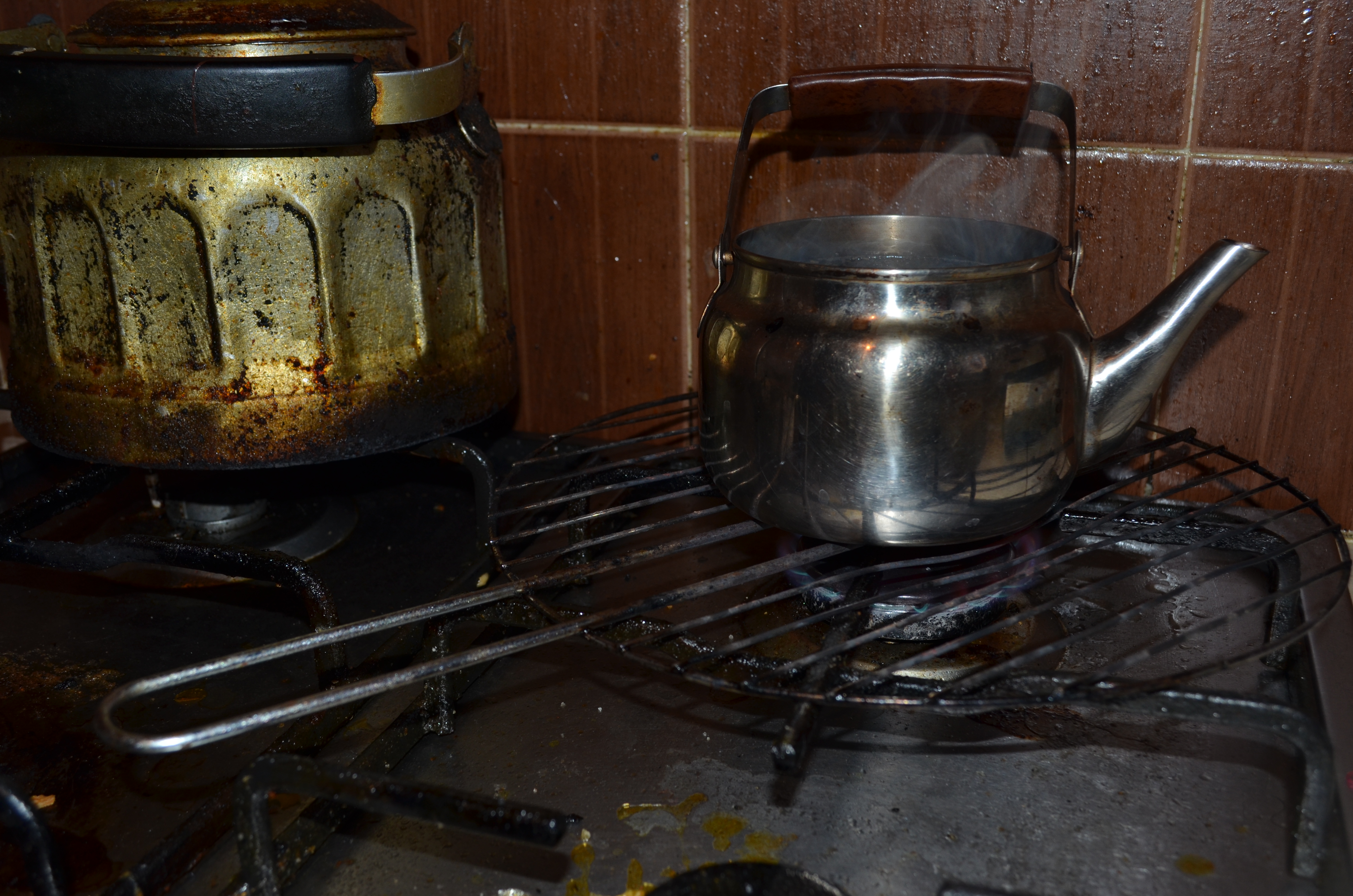
Before I knew it Mama was directing my attention around the room showing me how to dunk the hoobs into the egg mixture and place pieces on the pan. Do I know how make french toast? Of course. But that didn’t matter. Mama was so happy she grabbed me and laid a kiss on my forehead when I took a picture of the tea kettle (which she had me put on of course). She laughed when I tried to pour the tea.
In Morocco it’s traditional to start down down by the cup and stretch your arm up, lengthening the stream without splashing. My attempt was a little sloppy, but I like to think it got the job done.
More importantly, as I brought the trays out to the sitting room for everyone, I realized my breathing had slowed and I was smiling. It’s not full-proof but I think my anxiety’s going to be okay…for now.
Mint tea getting steamy in the final phase of prep (well, before we add absurd amounts of sugar)
Orientation is now officially over and all my time spent at the Center for Cross Learning will be for just that, learning. My journalism classes begin next week, after 8:30 AM Arabic classes. It’s starting to really set in that this is where I live. Like my first semester in Boston, it’s a question of when I stop walking the streets looking up (in addition to when I feel comfortable reaching across the table for an apple during dinner with my host family).
In a Thursday journalism session, the future of backpack journalism came up -as I’m sure it will throughout the semester. Mary Stucky, who runs our program and will act as the professor/editor of our group, sent us a link to this article from The New Yorker. She says this discredited idea of slow journalism is one thing we will work this semester to understand. Mary tells our group that we are here to do something that “parachute correspondents” cannot. Not only are we going to immerse ourselves in the culture, walking before we can run, but we will work closely with a journalist writing our story for a Moroccan audience.
After looking at Paul Salopek‘s story, I am reminded of the way that many journalists use Twitter to communicate. They send out 20-30 updates/day. Breaking news in 140 characters or less, with usually only a fraction of them dedicated to one story. Of course there is a place for this, but imagine if more people dedicated themselves to one project. If people all over the world could focus all their analytic energy to further communicate diverse cultures and languages in their own complex experiences. Surely our in our information driven society there is a place for this too.
Can I make a living from doing this? That is still to be determined. But I can always try.
I write this sitting in the living room in a djellaba on loan from my host mother. Today we are driving out of town for my “uncle’s” engagement party. This is why my mother dressed me this morning in an elaborate maroon dress and a beaded necklace.
Latifa is treating me more and more like a daughter. She takes my arm as we walk down the street and last night, when we went to the Hamam (Turkish Bath) to prepare for the party, not only did she force me to wash at least five times, but she scrubbed my back. Hard. I’m still recovering.
It’s experiences like this, going to the public bath with your mom and sisters-listening to friends and neighbors talk (and fight) crowded and naked- that I still can’t believe are real. With each day I can’t help but feel that I can be just a little more confident in my final story, that the days I’ve spent here in the Medina will reflect in my writing and reporting. I hope so. Last night while sitting in the Hamam, I had to wonder how many stories I had read or heard from journalists stationed nearby who may have never had this weekly experience (or another of relative normalcy). I again thought of Mary’s comments.
Coming up: An engagement party in Morocco, my first assignment and pictures of Samia’s flower doodles (now multiplying in my planner and notebook)
*warning: this post might be hard to handle for some*
It has taking me all day to sit down and begin writing. To be honest, this morning was tough.
To begin, I’ll take a moment to explain what the chicken situation is like here at Leighton. Charlie and Lynn raise the typical double breasted chickens you would find at any supermarket with two exceptions: they are brought up organically and tend to average about eight/nine pounds. As this is a homestead and not a large industrial farm, they only process enough chickens for themselves throughout the year and to sell locally, covering the cost of feed and other expenses.
The chickens are first brought onto the farm as chicks. Some will die due to the sickly nature of the species. As Charlie explained to me yesterday the birds raised for harvest in our country today are a hybrid developed for optimal meat density. They’re weak, not built for survival.
At this point their chests have swelled to such an extreme that some can hardly walk. In other words, it’s time to make some sacrifices.
Charlie and Lynn have found that is much easier and less expensive to process the chickens on site. The more than sixty chickens they’ve raised are processed in small groups. Today we did about half. Thursday morning we will probably finish. Everything is done and set to cool before 11:00 which allows us to work outside.
The first step is of course the killing itself. Charlie handles this part. The chickens are carried one at a time over to a metal cone where they are placed neck down. Their necks are split here and the blood drains down plastic tarp and into buckets below. The chicken dies quickly but is kept in place by the cone as its lower body experiences involuntary muscle spasms (the “death throws”).
The body is then submerged in a hot water bath to liquefy the fat around the feathers before being placed in an upright dryer-like machine which pulls them all away.
At this point the chicken is placed in front of me -armed with pruning shears and knives next to Rebecca, my fellow WWOOFer and Lynn, today’s expert chicken gut-er.
My job quickly became simple to do well while remaining difficult to stomach. Replaying it now, however, I realize it sounds worse than it actually was.
Basically, I made the chicken look less like an animal and more like the plastic-wrapped, neatly trimmed cut of meat sitting next to the turkey and bacon. All it took was for me to clip off the head and legs (collected in the bucket at our feet).
When I became more comfortable with that, Lynn showed me how to begin prying lose the lungs and windpipe. On the final chickens I even got up close and personal with the abdominal organs -wrist deep to where I could tug membrane away from skin. I tried to let my curiosity dominate my other emotions, but overall, I’d have to say I was surprised.
Going into this experience I thought I might be able to go numb after awhile, performing the same task with each bird. But I found that my feelings were quite the opposite. Every chicken I came across was different. I couldn’t depend on them being positioned the same way or having their lungs in the same place. The fact is that as I helped to create a meat-like appearance the mortality of the chicken became more real. I have a better understanding of how and why butchering an animal can be a cultural experience -of how certain communities can be overwhelmed with respect for the animals they depend on for food.
You should know at this point that I have been a vegan for the past year. I broke my diet in anticipation for my stay at the farm. I have to say that having taken part in this process hasn’t necessarily scared me into going back to veganism, nor has it given me any assurance that I should again start eating meat. Rather, this conversion of death into a resource has affirmed much of what vegetarianism has taught me about diet, nourishment and the way I can choose to live my life.
Lynn and Charlie both explained that they first began raising livestock because they wanted the control and knowledge that comes with seeing their food mature from start to finish.
As we killed the chickens, it didn’t smell like blood, like a hospital or a morgue. It smelled like homemade chicken broth. And as my hosts keep telling me, the more you do this the more chicken smells like corn. I have only been here two days and already I have a heightened awareness of what I put into my body and where it comes from.
I couldn’t write this without thanking Charlie and Lynn for being so attentive to our feelings about todays chores. We were always given an out if our emotions or stomachs got the best of us. Interestingly enough, the physical and emotional toll wasn’t the highest. While everyone spent the day visibly exhausted and hardly talkative, it would be inaccurate to say we were merely drained. There was something more occupying our minds.
I think Lynn put it best as we gathered for lunch. It’s hard work and emotionally difficult at times, but the worst part isn’t that. It’s the “responsibility that comes with it -the responsibility to do it right.”
You know that expression about the henhouse -the one you use when your mom and aunt won’t stop chatting about your second cousin’s new girlfriend or the neighbors’ estranged daughter?
Well, it’s completely accurate.
*anecdote assist*
Today I collected the eggs from the laying hens. As soon as I walked to the door they all flocked to the coup and started talking to me -or, more likely, about me. It sounds crazy, but I could tell by their cooing that they were sizing up the new girl -dancing around under my feet as they followed me from one nest to the next. One even flew up onto the ledge above the eggs, peeking into each compartment and taking inventory before turning her head to look at me, carefully surveying my every move…
But besides this initial loss of sanity, today was a perfect combination of hard, tiring work and periods of relaxation, whether alone or with our hosts.
Honestly though, I’m exhausted at this point. Which is why I will keep this short as I have to be up by 6:30 tomorrow.
Every few minutes I hear a chicken call from down the hill. One of the over thirty chickens which I will help to “harvest” first thing in the morning.
Yes, exactly what you think it means.


 Elizabeth Gillis