So I know I’ve been missing for quite some time now. Before my time in Morocco comes to a close, I wanted to share some pictures of my travels featuring Moroccan monuments, fellow study abroad-ers and of course a few four-legged companions. Not to worry! I should be back blogging soon. Right now I am focusing on my big story (like any well-respecting journalist).
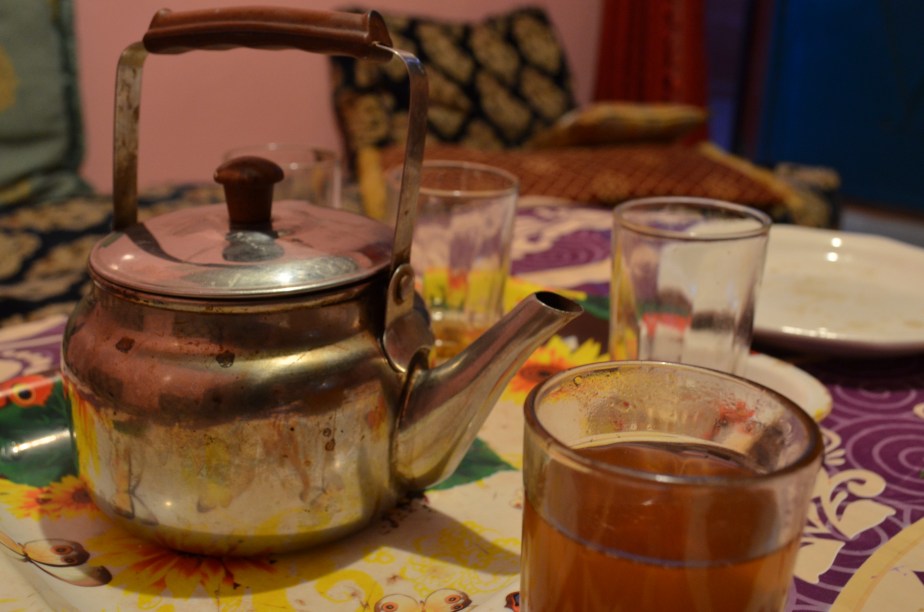
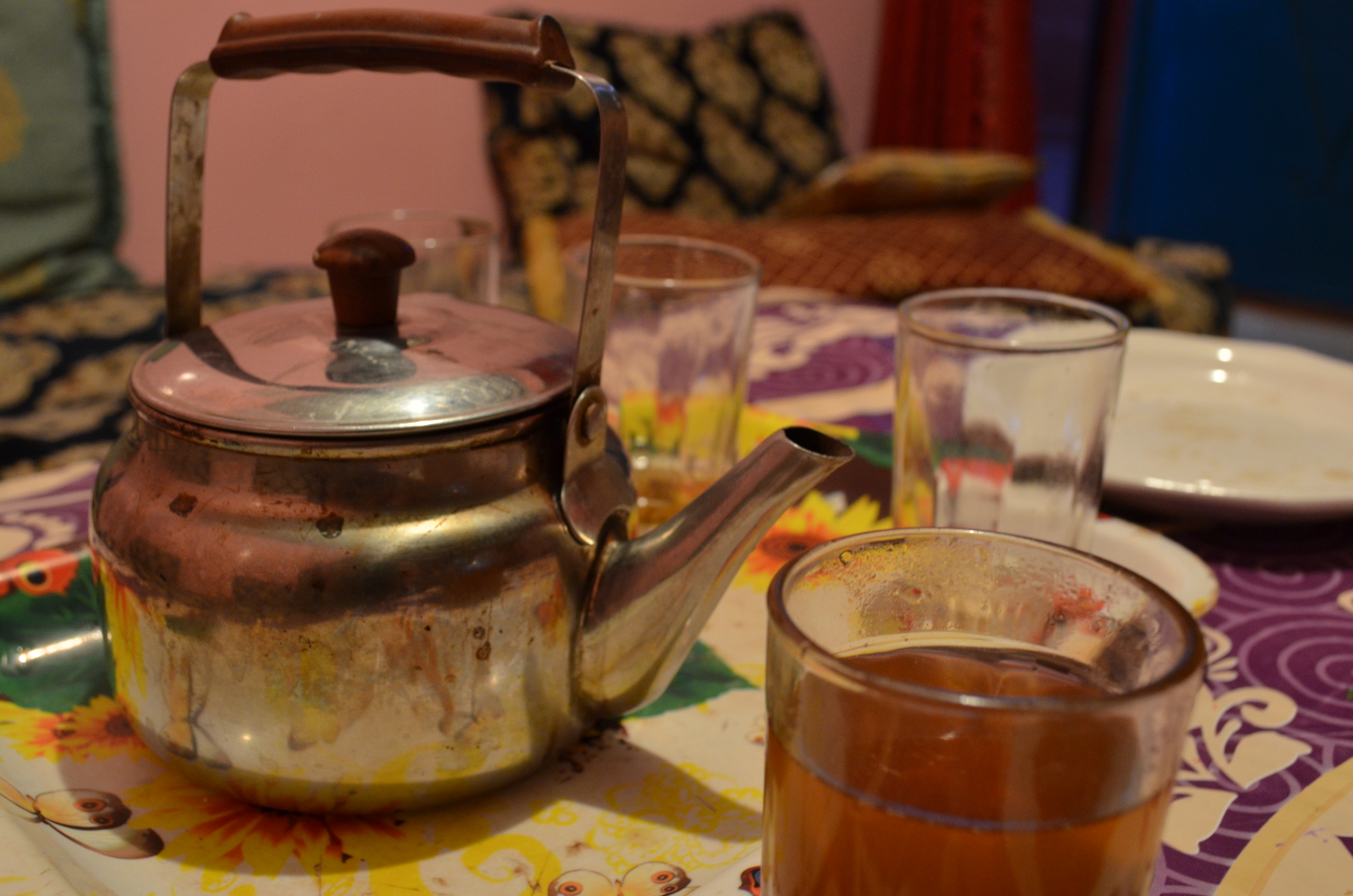
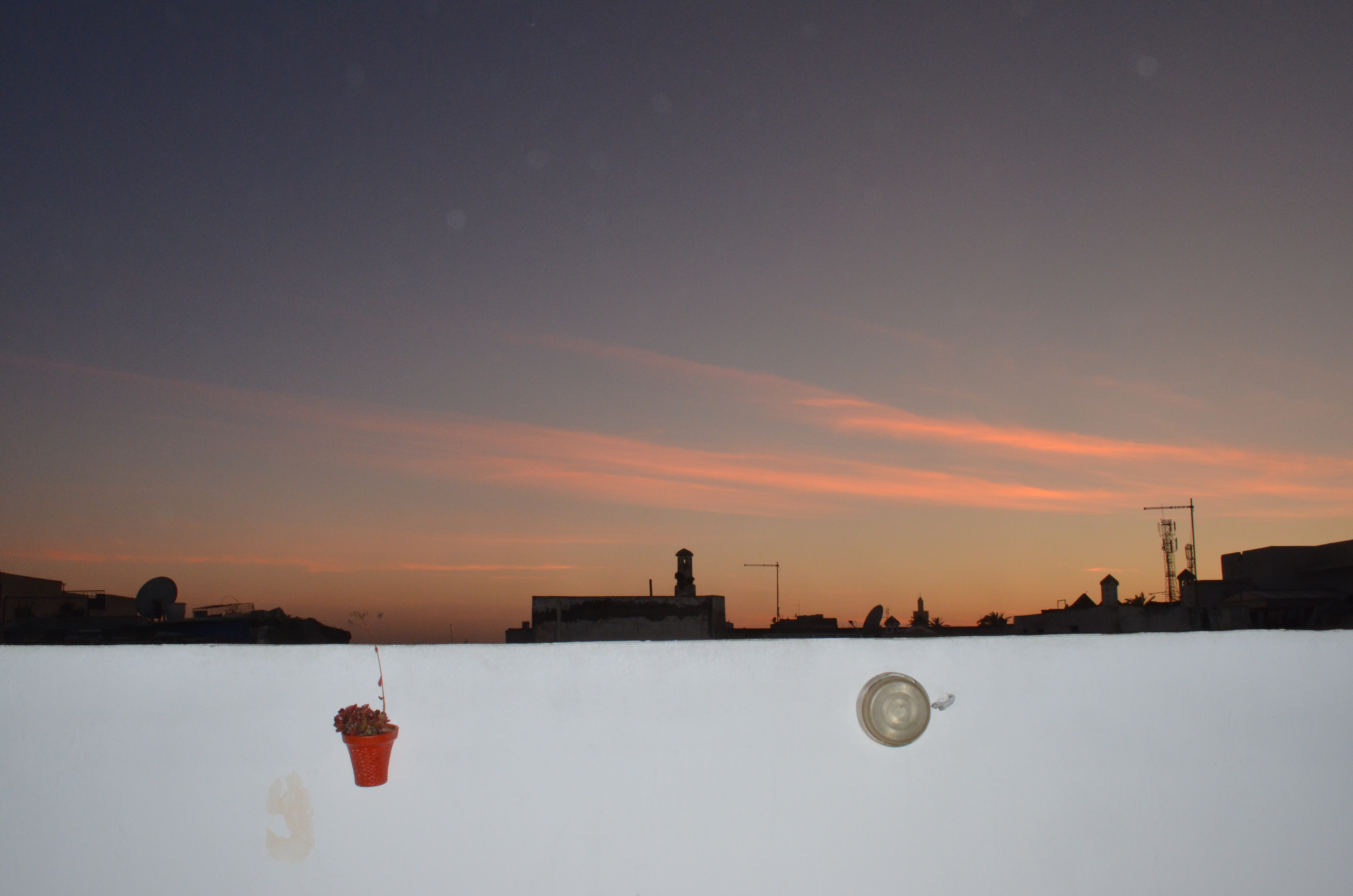
Mint tea is a daily break from my afternoon crunch. And a chance for me to get my sugar fix. Three giant cubes in this pot!
Those of you who know me well are probably aware that anxiety is my middle name. The Vikings would have dubbed me Liz the Worrier, and I would ironically die in almost every horror movie. My fear creeps in at the very insinuation of the word deadline.
You may be thinking, “…and this girl wants to be a journalist?”
Short answer: Yes. What could be more life-affirming than facing an all-consuming fear everyday? What could be better than learning to let go?
Mastering this craft has the added element of conquering my anxiety on almost every project I do. I’ve tried yoga, running, deep breathing exercises and of course, trying to ignore it. No matter what i do, or how small the project, I hate the feeling I get when a story is out of my immediate control. I will pace for the greater part of a half hour waiting for a source to reply to my emails and my eyes will always dart to the nearest clock when I hit a dead end in my research.
So here I am with my first assignment…in a foreign country…in another’s home. I’m tapping my fingers. I’m sighing. I’m pacing and furiously typing.
My sister is worried.
“Labez?” -“Jayeed” -“You should take a nap.” -“Shokran. But I’m not tired.”
But in a Moroccan household there is one occasion that I am forced to break for. Food. “Maj, Liz maj!”
So on Saturday, between scanning for articles and brainstorming interview subjects, I walked upstairs and peeked my head into the kitchen where Mama and Papa sat. Moma preparing for tea. Papa gazing past her out the window and smoking.
At this point, I think my family has realized that I like to help cook. When she saw me, Mama clamped down on my arms and pulled me over to the counter. She put a bowl of egg in front of me and dropped a fork inside.
Before I knew it Mama was directing my attention around the room showing me how to dunk the hoobs into the egg mixture and place pieces on the pan. Do I know how make french toast? Of course. But that didn’t matter. Mama was so happy she grabbed me and laid a kiss on my forehead when I took a picture of the tea kettle (which she had me put on of course). She laughed when I tried to pour the tea.
In Morocco it’s traditional to start down down by the cup and stretch your arm up, lengthening the stream without splashing. My attempt was a little sloppy, but I like to think it got the job done.
More importantly, as I brought the trays out to the sitting room for everyone, I realized my breathing had slowed and I was smiling. It’s not full-proof but I think my anxiety’s going to be okay…for now.
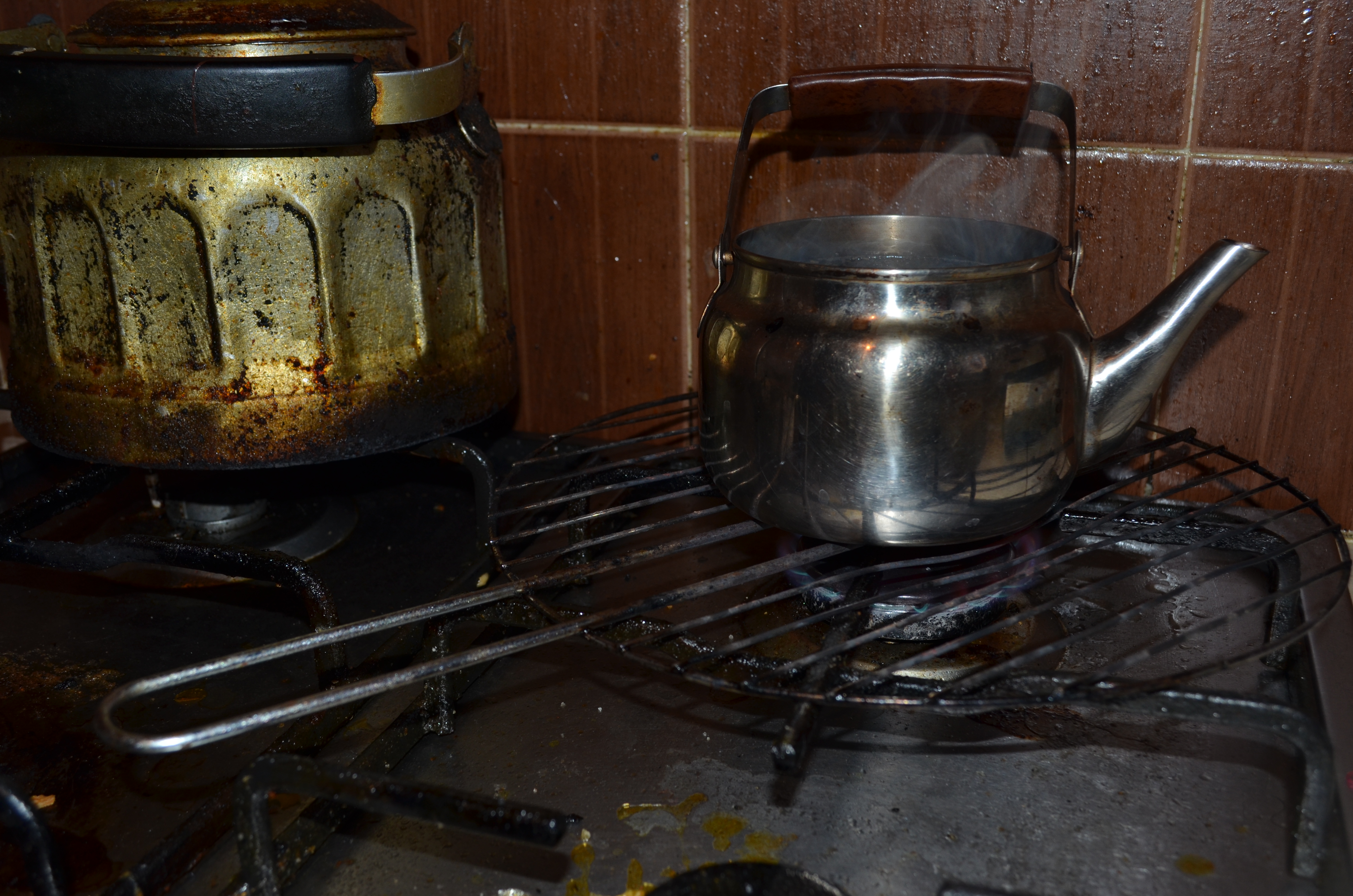
Mint tea getting steamy in the final phase of prep (well, before we add absurd amounts of sugar)
This week I had my first week of classes, first Arabic quiz and now contemplate my first assignment. It’s been a lot to take in, and my brain has never endured such a workout. We begin each day with two hours of Arabic. We have started to learn the alphabet, but everyday there is new vocabulary. Even more confusing, we learn Fu’sha (or Modern Standard Arabic), but in the street and at home can hear anything from French to Darija (Moroccan Arabic). Note that Darija is often uses a completely different word to mean the same thing. When my host mother tries to teach me new words she’ll say them in Darija then French, and then sometimes in Fu’sha or Amazigh (aka Berber, or those who where native to Morocco prior to Arab migration). Communicating here is no joke.
Speaking of which, we have also begun discussing the media in Morocco. Besides Arabic classes my days have included a series of lectures and discussions about both journalism and Morocco.
Earlier this week we spoke with Driss Ksikes, the former editor-in-chef of Tel Quel who was tried in Morocco a few years ago after a humor issue went to far in its commentary on religion, sex and culture. He was given a suspended sentence of three years, but left the paper when told he should correct himself in the future.
One of the problems in Morocco is that censorship in the media is not highly publicized. Unlike China and North Korea, the government allows for a relatively free press, with a few exceptions: Any careful journalist knows what not to say about the monarchy, Islam and the Western Sahara (disputed territory to the South). As foreign journalists, our reporting isn’t guided by the same rules, however Al Jazeera, for example, was forced to close it’s base here recently, proving just how touchy the government is on the topic of the Western Sahara.
By the end of the week (and after another couple discussions) we looked at ethics, and again we looked at the importance of a program like this. More importantly, we looked at the importance of giving journalists the chance to discuss amongst themselves.
This is where taking courses in journalism can come in. I know journalism degrees make a great punchline. You’re going to school to learn a skill that traditionally people pick through experience. But in an age when anyone can turn on a computer or pick up a camera and make themselves sound well-informed, I think it is ever more important that their are others who follow the standards and ethical guidelines constructed through generations of trail-and-error. By simply talking about the difference between holistic and lacking reporting, we can create an environment of “news literacy” as Mary calls it. Society can learn how to navigate information overload so long as we take the time to understand what is credible and how every story could have been improved.
But as of now, my computer is out of battery and I have to go. So with a stomach full of cous-cous I’m running off to meet my journalism partner for the next three months! More to come…
Orientation is now officially over and all my time spent at the Center for Cross Learning will be for just that, learning. My journalism classes begin next week, after 8:30 AM Arabic classes. It’s starting to really set in that this is where I live. Like my first semester in Boston, it’s a question of when I stop walking the streets looking up (in addition to when I feel comfortable reaching across the table for an apple during dinner with my host family).
In a Thursday journalism session, the future of backpack journalism came up -as I’m sure it will throughout the semester. Mary Stucky, who runs our program and will act as the professor/editor of our group, sent us a link to this article from The New Yorker. She says this discredited idea of slow journalism is one thing we will work this semester to understand. Mary tells our group that we are here to do something that “parachute correspondents” cannot. Not only are we going to immerse ourselves in the culture, walking before we can run, but we will work closely with a journalist writing our story for a Moroccan audience.
After looking at Paul Salopek‘s story, I am reminded of the way that many journalists use Twitter to communicate. They send out 20-30 updates/day. Breaking news in 140 characters or less, with usually only a fraction of them dedicated to one story. Of course there is a place for this, but imagine if more people dedicated themselves to one project. If people all over the world could focus all their analytic energy to further communicate diverse cultures and languages in their own complex experiences. Surely our in our information driven society there is a place for this too.
Can I make a living from doing this? That is still to be determined. But I can always try.
I write this sitting in the living room in a djellaba on loan from my host mother. Today we are driving out of town for my “uncle’s” engagement party. This is why my mother dressed me this morning in an elaborate maroon dress and a beaded necklace.
Latifa is treating me more and more like a daughter. She takes my arm as we walk down the street and last night, when we went to the Hamam (Turkish Bath) to prepare for the party, not only did she force me to wash at least five times, but she scrubbed my back. Hard. I’m still recovering.
It’s experiences like this, going to the public bath with your mom and sisters-listening to friends and neighbors talk (and fight) crowded and naked- that I still can’t believe are real. With each day I can’t help but feel that I can be just a little more confident in my final story, that the days I’ve spent here in the Medina will reflect in my writing and reporting. I hope so. Last night while sitting in the Hamam, I had to wonder how many stories I had read or heard from journalists stationed nearby who may have never had this weekly experience (or another of relative normalcy). I again thought of Mary’s comments.
Coming up: An engagement party in Morocco, my first assignment and pictures of Samia’s flower doodles (now multiplying in my planner and notebook)
Today I met the five people I will be spending the next six weeks with (and their 5-year-old neighbor). I played mime. Kindergarten Arabic script books were involved.
But we won’t start there. In fact there is an entire day in between that still must be addressed.
Wednesday morning began with preparation for the arrival of our home-stay families. A brain aching two hours of what is easily becoming one of the most beautiful languages I’ve ever tried to speak. Already I am in awe of the careless way pedestrians throw a hard H and sweet LRRRR into the middle of any word. At least trying to speak Darija, or Moroccan Arabic, is turning out to be fun. I just would give anything for a better memory right now.
Later in the day, we hit the streets for a duel assignment. Our program split into groups to create a guide to the city on everything from transportation to buying textbooks (ours). We also had to practice bargaining—jargon for which we had learned the day before.
Just so you know, I hate bargaining. I always leave just wishing everything had a price-tag. I like clarity in my exchanges. So it’s safe to say I wasn’t overly enthusiastic about this experience.
But no matter how much I worry, Morocco never fails me.
It wasn’t soon after we’d left the Center that Allison and I accidently broke away from our five person group in the bustling Medina market. We had already tried and failed at bargaining once. I promise we really did try!
Having no luck with jewelry, we make our way to a shop ceiling of scarves.
“How much?” Al asks in French –a phrase I most likely forgot once again.
“100 MDH”
This is too much for our 10 MDH (about $1.20) limit.
Still we try, on and on in each shop we enter, with every non-English speaking vendor on that street. One man pulls out his notebook explaining in French and Arabic that he would in essence pay us for the privilege of taking the scarf away. Another man approaches me with big eyes, outstretched hands and a mouth-full of Arabic after my modest greeting. “No, I can’t continue this conversation in your language because yes, I am American.”
On the plus side, I brushed up on French numerals. And surprisingly, we left without a single person hating us that morning. In fact, I think it’s safe to say we made friends.
I didn’t understand what people meant when they said Moroccans are polite. The people I’ve met have been so easy to get along with. We laugh together without ever knowing exactly what the other person is saying. After an exhausting explanation of our meager funds-in which we did not buy one of his scarves-a man who owns a shop at the end of the street-and laughs in a way that stretches into his chest and across his shoulders- reached out to shake our hands and wish us a good day.
A young man with particularly good English a block away was all smiles when I said “Besslama” as we walked away, as was a woman in the bookstore across the street. Even when I mispronounce something locals are often so pleased with my attempt they’d rather laugh it off then scoff at me for wasting their time. With an environment this encouraging, I’d be content intensively studying Arabic for five hours per day (luckily we will only be doing two).
Al and I learned it’s much easier (and cheaper) to hail a cab in Rabat, but that you might have to share. Since everyone that day seemed to like us, not only did the previous passenger start a conversation with me about school, but the driver didn’t start our meter until after he dropped her off (apparently this isn’t normal).
That night when we returned to the Center, our program coordinators and amazing cooks had prepared a special final dinner for the entire group, complete with drummers.
Thursday began as just a mess of emotions. What if my home-stay family doesn’t like me? How are we going to communicate? What if they have a Turkish toilet? Luckily it ended with me exactly as I am right now. I already miss the friends I made this week (yes I’ll see them tomorrow morning), but I have no reason to complain.
My home stay family lives in a two-story house in the Medina with a pink living room and a red terrace. The houses here all follow a very similar traditional structure. They are like apartments and some are higher than others. Another student in the journalism program is my neighbor and earlier today I was called out onto the terrace to check-in as he stood below. In the living room (and in my guest room) couches line the walls. This, of course, allows for families to have plenty of people relax any way they want to as they watch TV, share meals or drink mint tea, as we did tonight, sweetened with honey and with different breads and toasts on the side.
Over tea I tried out my new survival Arabic (with a notebook cheat sheet) and found out that “study” when incorrectly pronounced, can sound a lot like “poopy”. It’s embarrassing but at least I‘m getting everyone to laugh.
When I walked in the house I immediately had a good feeling. It smelled like cleanliness. And if anyone knows my mother they would understand why that reminds me of home.
The family is comprised of three daughters. The oldest is my age and the youngest is five. Everyone is sweeter than I could have possibly imagined. “Mamma Latifa” hand fed me little meatballs out of the Tangin when she decided I wasn’t eating enough. She then gestured around the table and clasped her hands together. Looking straight into my eyes she repeated something to me in Arabic. From my right I heard the translation, “She says when you want something from the table, you take it. We are all family now.”
Sitting at the table eating Tangin with a group of Moroccans can easily give you that feeling. There are no individual plates just fruit, sides and pieces of bread you use to pinch meat and vegetables in the middle of the table. The serving dish is your plate. It’s everyone’s plate. And if I could choose any way to experience family time with my family it would be while piling large amounts of food into my mouth. Without shame. Beneen Bezzaf!
My sisters are fantastic. Not to say that my sister americania is great but to be honest she isn’t half as nice. My oldest sister is so helpful, willing to go out of her way to make sure I’m comfortable, and that includes ensuring that I have someone to talk to. My second oldest sister, slightly younger than me, speaks less Arabic, but still watches my face when I’m not looking and, like her mother, will make sure with a simple “Lebez” or “You good?” that I’m not hiding any frustrations or anxieties.
Now my baby sister. She is perfection. When I arrived she ran around me, a little shy but incredibly curious. It wasn’t until I started to try and show them my Arabic that this 5-year-old girl found her way in. Wiggling around next to me on the couch she began to have me repeat phrases after her until I understood well enough to complete what she was trying to have me say. She’d walk away and come back only to ask me again. If I got it right she’d nod with her entire body and say “Bravo!”
She’s five.
When I took out my notebook she wrote her name for me and I in turn wrote mine for her. This turned into a little game that I’ll be finding remnants of for months. Quite literally. She wrote all over my planner.
Just before bed she came down to my room again as I unpacked pointing at everything and asking “Schnoo?” She tried on my hat and lipstick and gasped when she saw my camera.
I have a little sister with two little buns on top of her head, the curly pieces falling out of a purple clip. She leads my through the Medina by the hand and tells me not to step on grates. She is my petit professor.
Welcome to Morocco! The beach outside the Medina wall.
To begin, let me apologize for today’s (and any future) belated posts. I’m still adjusting to limited computer access, although I’m not necessarily complaining.
In Rabat I can access WiFi in a few places throughout the city: where we take classes in the Center for Cross Cultural Learning, at the hotel and at some cafes. I can’t read my email while walking down the street or laying in the comfort of my bed. The simple act of checking notifications means greeting the world. This might be an optimistic view, brought on by a over-enthusiastic novice, but I say “good. Let them have their Twitter updates and Instagram back home.”
After becoming accustomed to my iPhone and 3G, constantly checking emails and social media has become habitual. In these past three days, I’ve appreciated the sights and sounds of my new environment without constant distraction. I am remembering that journalism does not only mean being alert to every breaking news update. By taking on that title, busy people all over are relying on my powers of observation.
Something I noticed today was that I’m not alone. While plenty of men (yes, mostly men) hang out around the city during the day at cafes, in storefronts and parks, only a handful of people are on their phones. If they are, they’re talking. No, not scrolling, playing tetris or direct messaging. Real human contact. How stimulating.
I want to work abroad, to travel to the story wherever it takes me. As a journalist, I have realized that I depend on the internet too much as it is. I hope this semester forces me to become comfortable with the traditional ways of finding answers, people and stories. It may not be faster and it will definitely mean speaking to people in confused broken Frenarabish while swallowing the exploding nervous frog in my throat, but I’m already here so bring it.
And did I mention the amazing people in this program with me? i won’t go into details to respect their privacy and the sanctity of our still developing relationships but let it be enough to say that my fellow students have skills beyond those I had previously thought a journalist required. We are all wonderfully curious and adventurous. With each day I am more taken with the different skills each person brings to the table beyond basic language comprehension and great questions. I can honestly say I am excited to work with my group. There is so much to learn not only from this new culture and country, but from my peers -one of the beautiful things about bringing people together with such specific interests.
I meant to post this yesterday to describe my first full day abroad, but I’ll try to now insert a portion of the wealth of information I discovered today as well:
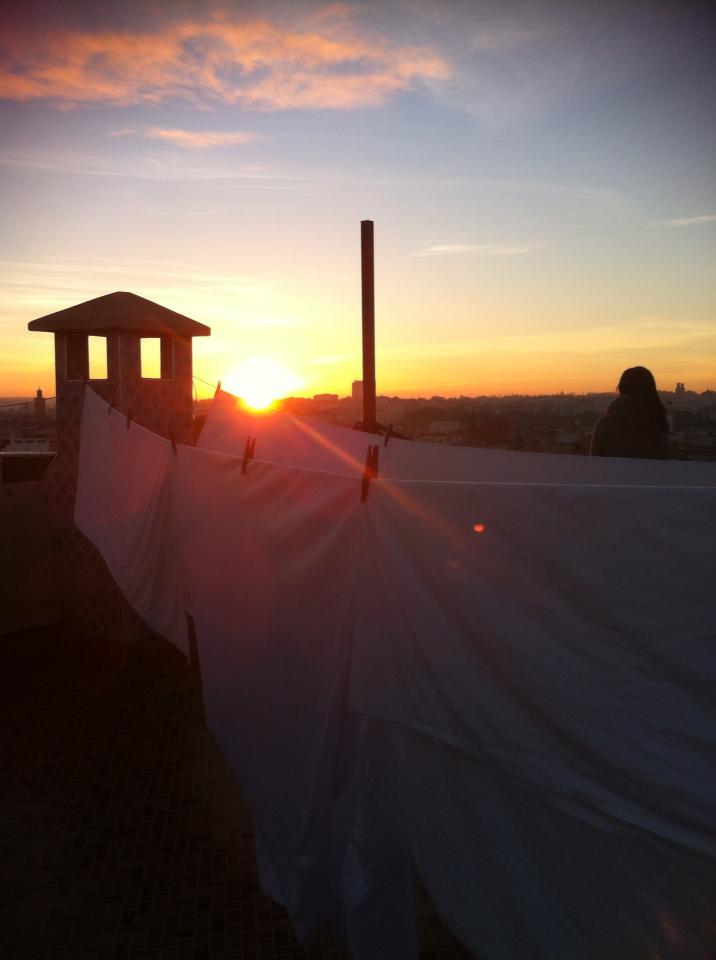
The eleven students in the SIT Journalism program had their first full day in Morocco Monday. It began with early breakfast at the hotel as the sun saturated the rooftop clotheslines in Rabat’s Medina.
The view from the terrace of the hotel morning numero uno.
We then became better acquainted with the Center for Cross Cultural Learning at which we will take classes for the next eight weeks. The building is set off from the main roads, entered via alley. Colorful mosaic tiles cover floor and ceiling throughout the interior. We ate on the first rooftop terrace, but many retired to the second where a calm breeze picked up off the Atlantic to take the edge off a warming sun.
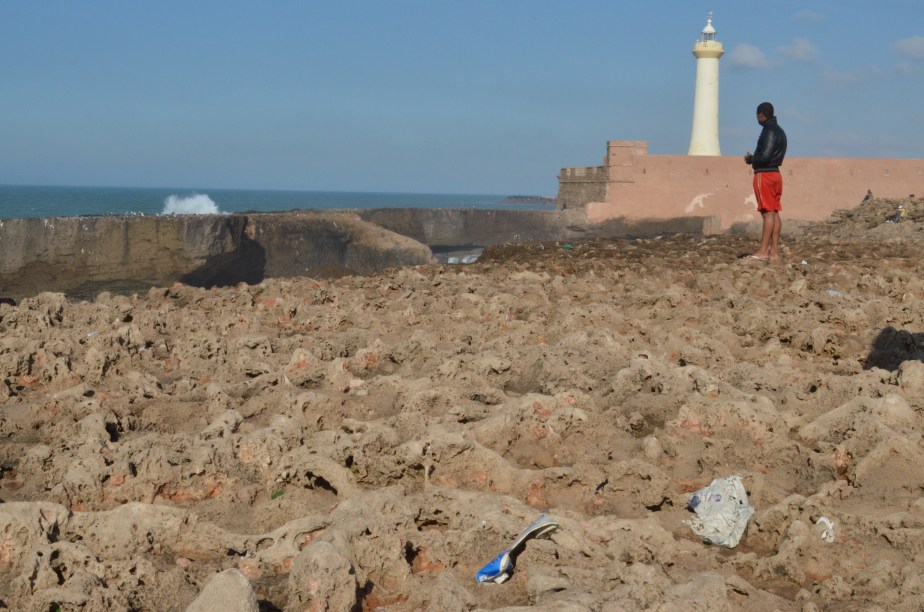
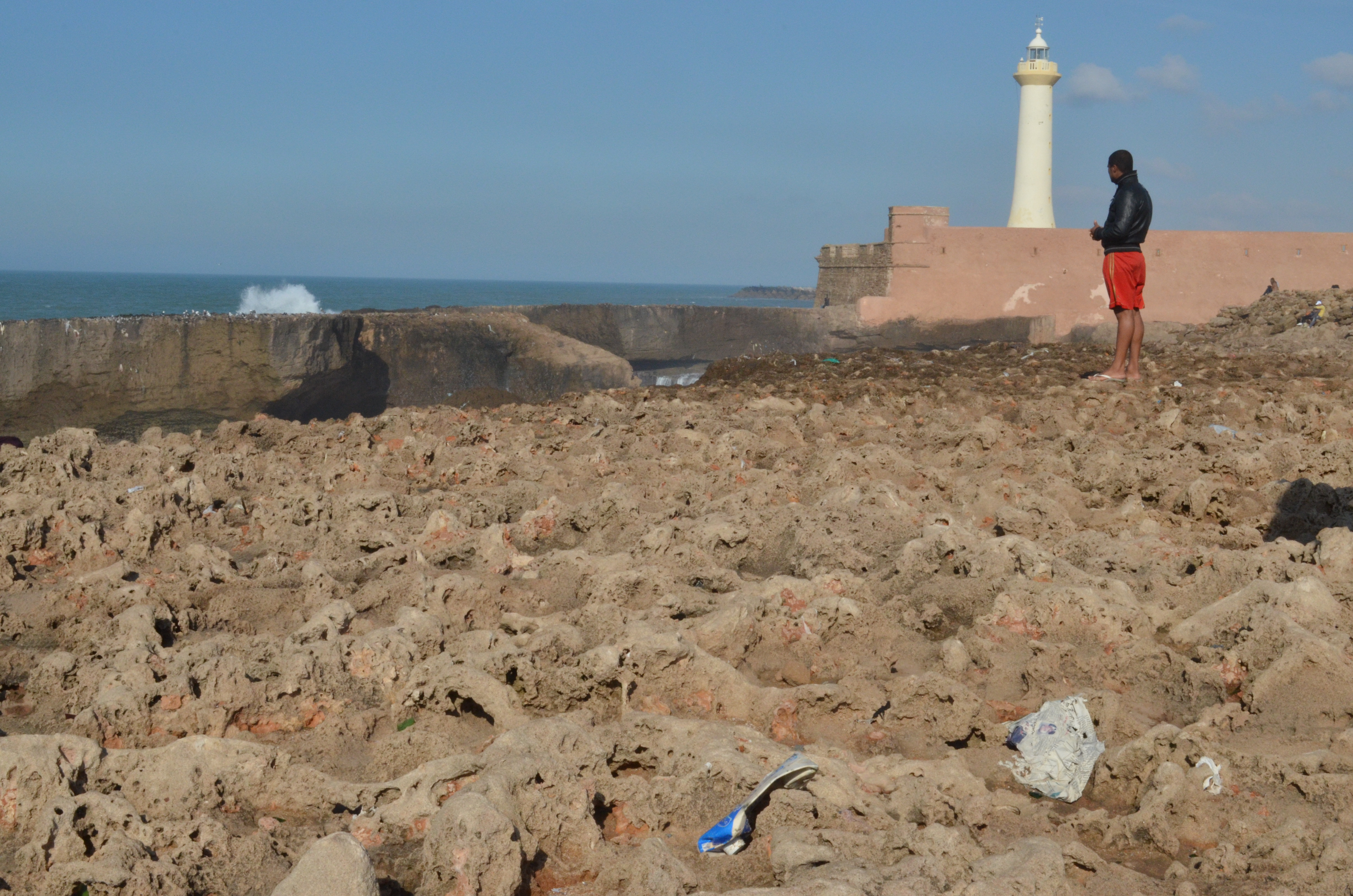
By our afternoon walk, it was about 65 degrees (Fahrenheit). We started at the beach where a considerable surf (relative to the Sound…) ran up and seeped over porous rock. Litter, not unfamiliar to the city streets, was abundant.
Locals sat on the upper rocks looking out at the ocean. This stretch was not as populated as the beaches and parks we passed coming from the airport, where small groups and families crowded the sidewalks and grass.
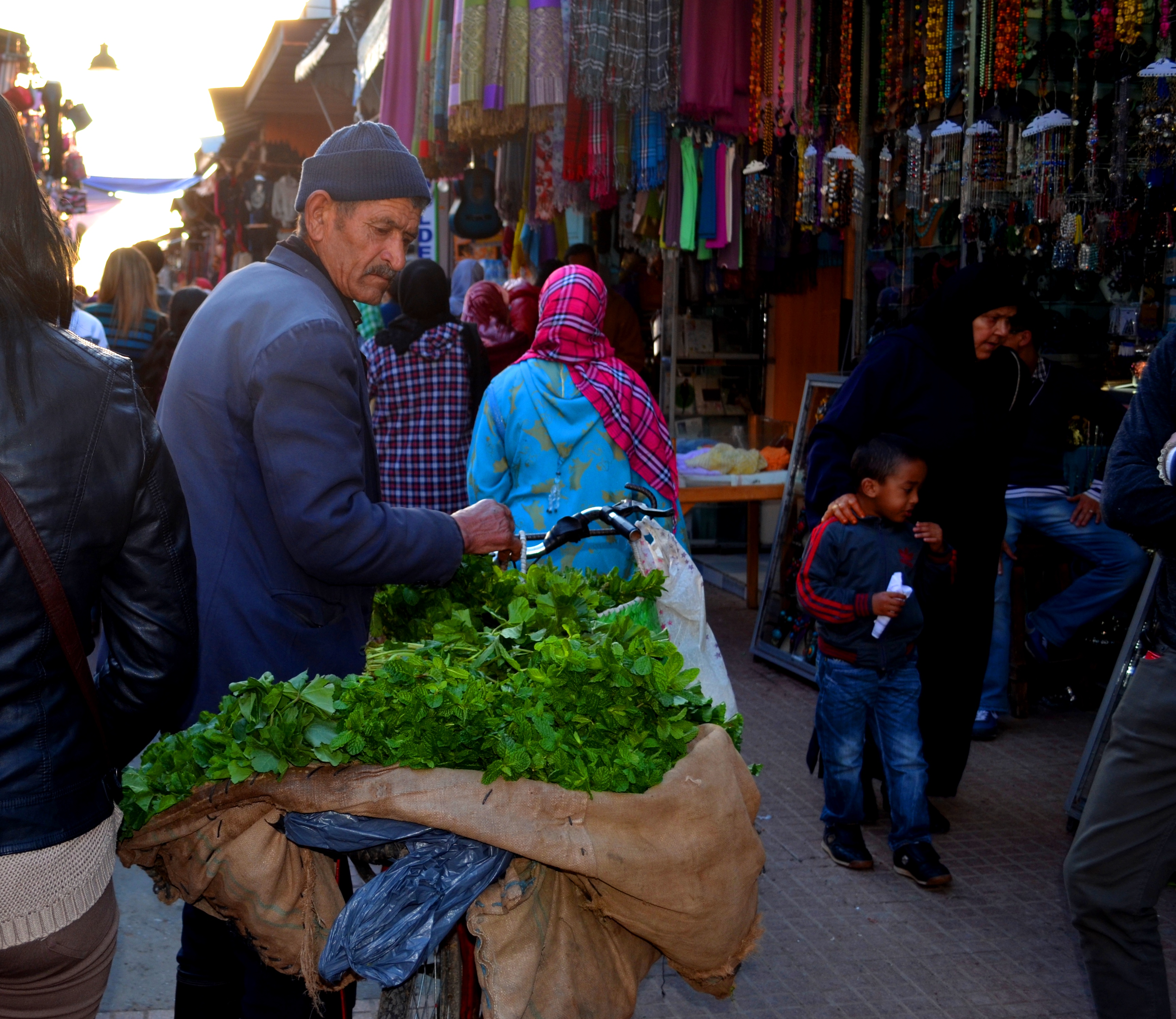
We saw the greatest number of people in the narrow market street of the Medina, where I followed the path carved by this man and his bike.
A man leads his bike through the crowded market in the old Medina.
There are many stray animals in our area. A man in the park fed cats out of a paper bag next to a patio where children played ball. Small children play soccer in squares and alleys alike (even through our feet as we stumbled by).
The day ended back at the Center where we ate dinner outside. Morocco has the most amazing oranges and peaches spiced like apple pie.
By this weekend we should be with our home-stay families and know some “survival Arabic”. Our studies really begin next week, but on Tuesday we had our first big test. After being dropped off in town, we had to find our way back to the center. Luckily I found my way to a cafe we had stumbled upon the night before, but walking in the street without a group while making observations was an experience all its own. I learned that once I learn Arabic it will be easy to practice. Many people, including a woman asking directions, approached me already speaking it.
The sunset from atop the Center for Cross Cultural Learning Monday evening.
Still to come: survival Arabic, taxi adventures, Moroccan drummers, my home-stay family and maybe a Turkish toilet.
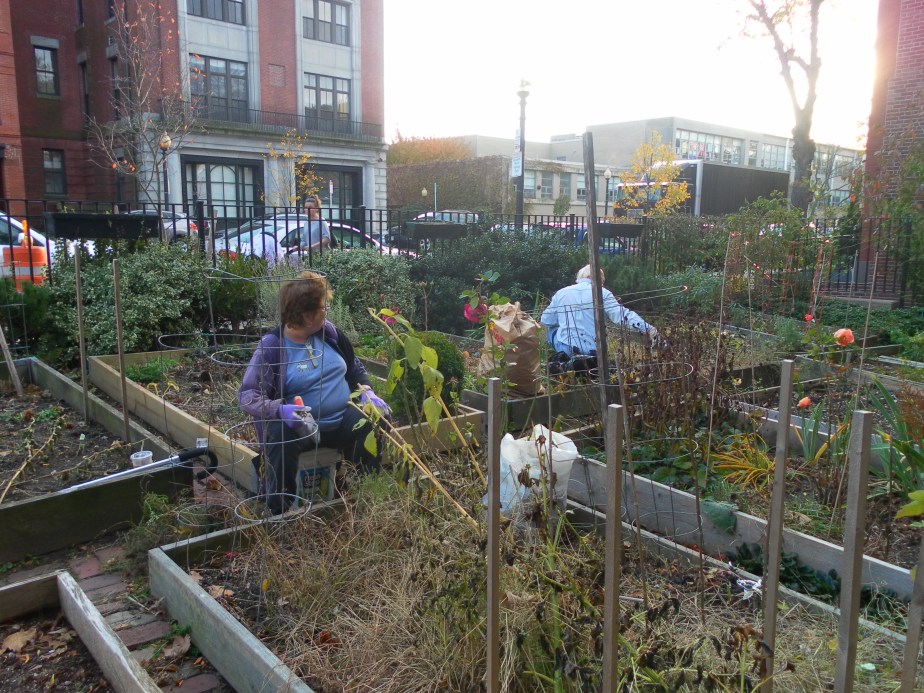
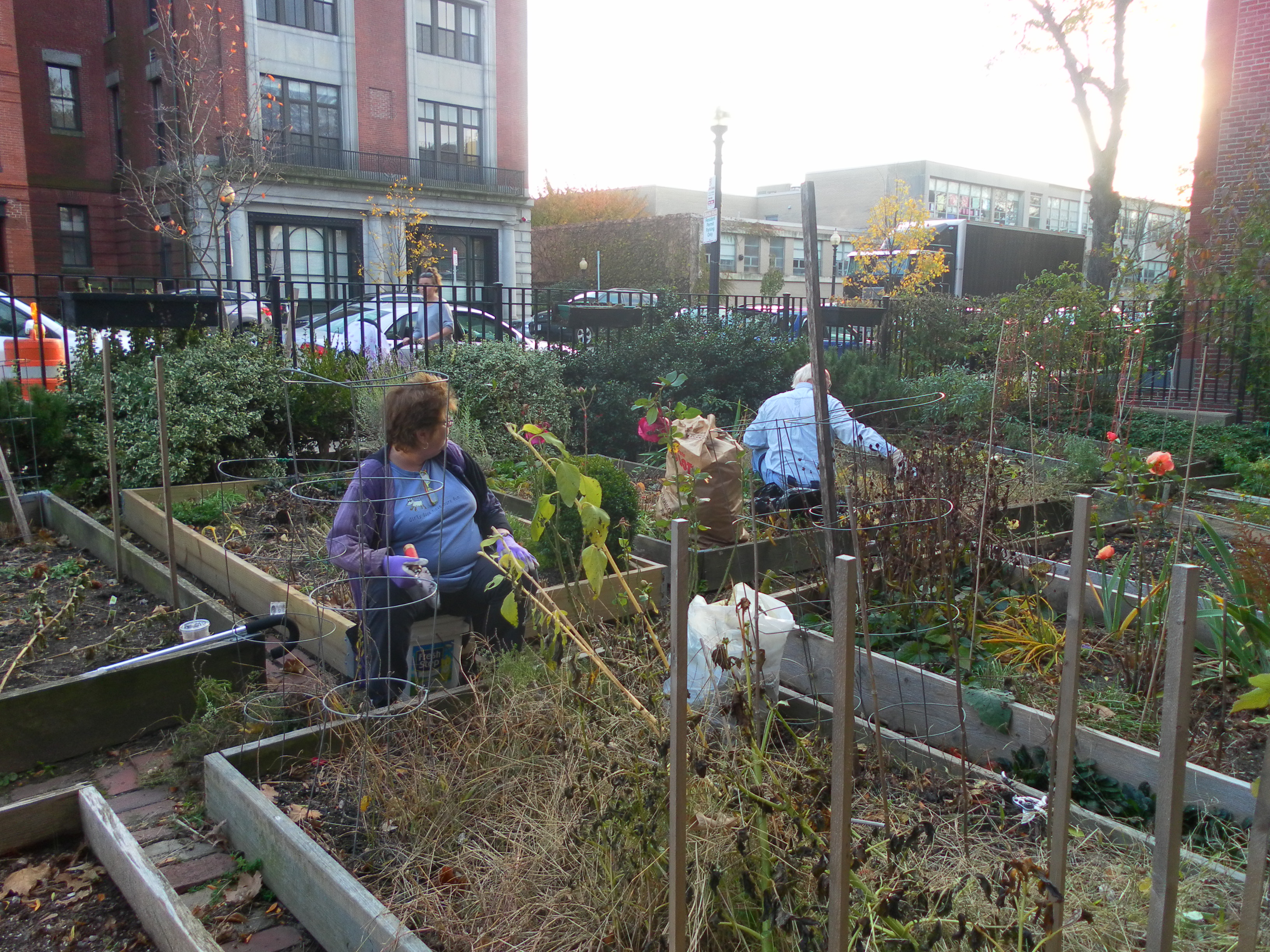
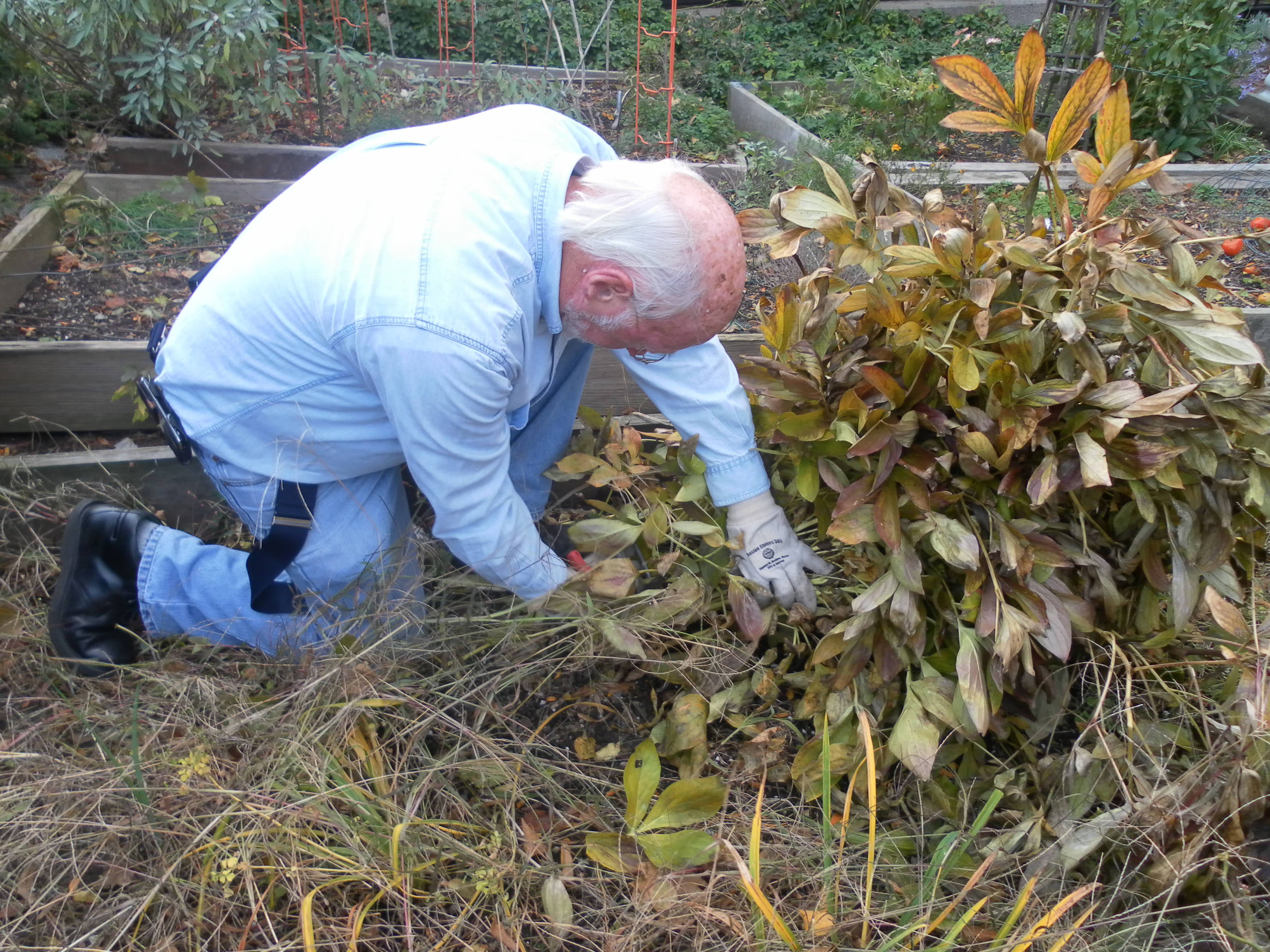
Long-time friends Sharon Kelly and Paul Duffy tend to their plots in one of the many Boston community gardens protected from development by local residents and city organizations.
By Elizabeth Gillis
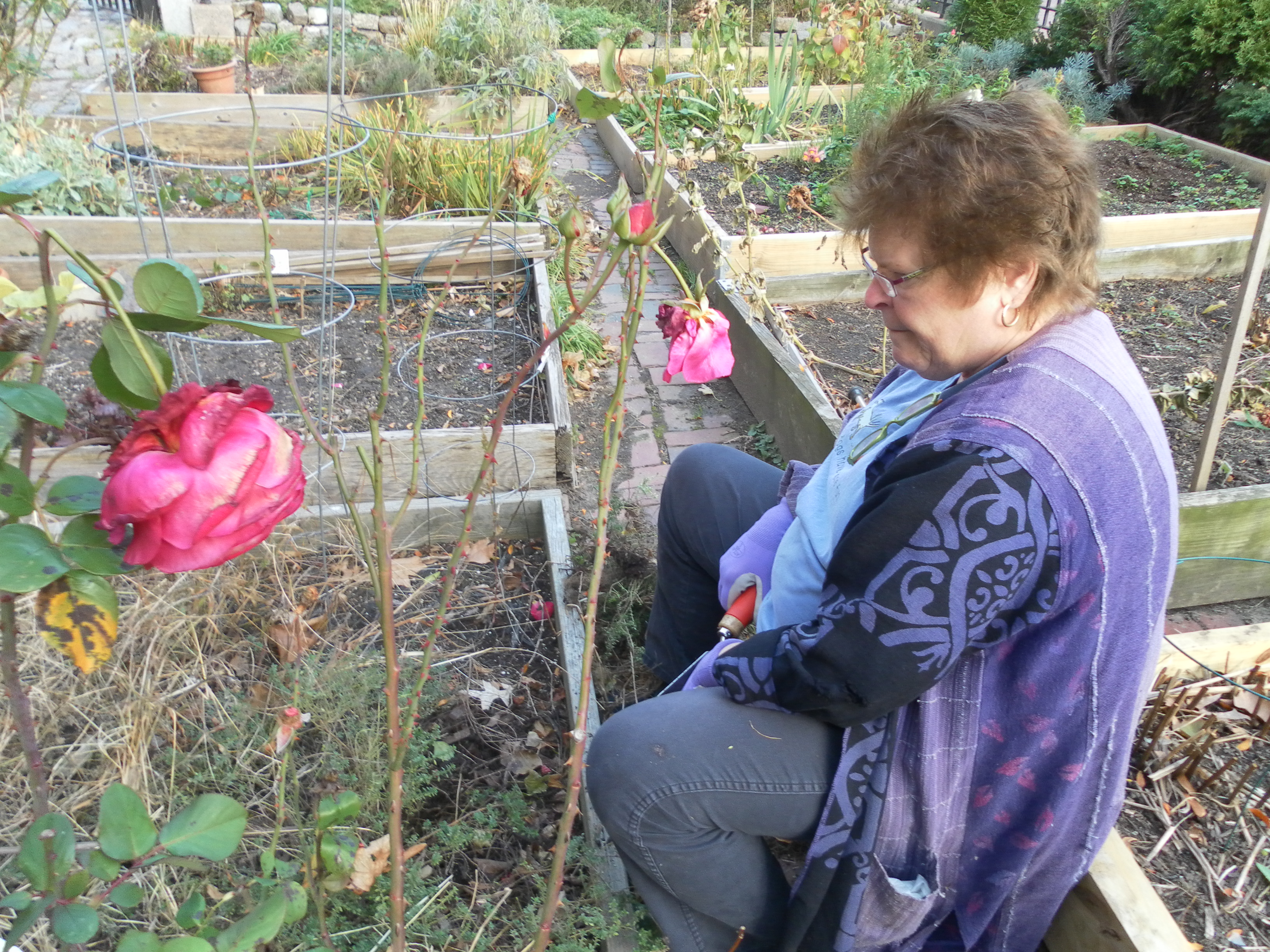
Sharon Kelly surveys her garden beds from atop a re-purposed cat litter box on the corner of Clarendon and Warren Street in Boston’s South End. Digging into the soil she removes unruly thyme next to the pink rose stems she will soon cut down in anticipation of the cold months ahead. It’s an unusually warm afternoon in mid-November.
Sharon Kelly sits next to one of the two beds she tends to at a South End community garden.
“On a day like this you go outside and use it,” she says to Paul Duffy, who has just arrived to tend to a box on her left.
“I grow peonies…roses…lilies….and weeds,” he says. “I do very well at weeds.”
Kelly and Duffy have known each other for almost 20 years. Duffy has lived in the neighborhood since he was a boy, working at a florist’s shop near where the community garden is today.
Kelly has lived here for about 25 years.
“My grandfather taught me how to garden years ago,” she says, “and when I first got here there was a stake in the middle of the garden and it said ‘For Rent’.”
They are regulars in the garden. Duffy remembers when the lot was occupied by a building falling into disrepair in the early seventies. Kelly says she has seen it grow.
“There was no water here so if you wanted to water your plants –if God didn’t do it for you- you had to bring it yourself,” she says. “I got some pretty big arms from doing that.”
Paul Duffy pulls out support wires from his flower bed in a community garden located on the corner of Clarendon and Warren Street.
The space is now kept by 19 gardeners according to coordinator Kaysie Ives.
“I have a backyard,” she says, “but very few of these people would have the chance to garden.”
Ives says that the neighborhood is grateful to have this space because the South End has traditionally lacked open green space.
“It’s a really important link to the neighborhood,” she says. “People always stop and talk to us when they’re walking by.”
Boston has about 150 community gardens in neighborhoods across the city, according to the Boston Natural Areas Network, an organization that has worked to preserve urban green space since the 1970’s.
There is a movement in many cities working to change the culture of agriculture in urban areas. Whether it be increasing usable green space through community gardens or buying groceries at the neighborhood farmers market, urban residents are looking local.
Proponents of localization and urban gardening say there are many positives to a local lifestyle. They point to effects ranging from increased urban green space to sustainability and support of small farms and the local economy.
Experts say going local has another less talked about effect: people are getting to know their neighbors.
“I think there can be a fear and distrust in areas that are urban. People can keep to themselves sometimes,” says Karen Chaffee, stewardship manager for the Boston Natural Areas Network. “Community gardens can really pull people out and start communication in a neighborhood.”
The Boston Natural Areas Network began working with community gardeners in the 1980s. As one of the main organizations charged with conserving green space in Boston, they noticed a lack of protection for these public plots.
Today they work with residents to prevent city development from extending into public gardens throughout Boston.
“Basically things have to be initiated by the neighborhood or people who want to see it happen,” Chaffee says. “We know about where plots of land are available but there has to be demand.”
She says there are many reasons why people ask for their help in starting up a neighborhood garden. Some residents don’t even know how to garden when they first bring up the project.
“People might be tired of seeing an unused space in their neighborhood, a derelict thing collecting trash, an eyesore,” she says, explaining that the benefits extend beyond food production and neighborhood greenery.
Chaffee says in a city people can easily get by having little interaction with their neighborhood, but when residents share in a project like a garden, they take more ownership of the space overall.
“It’s more eyes out and about in the neighborhood. It draws people out of their homes,” she said.
She says gardeners use the space for a variety of reasons. One person might hold a fundraiser for another group there while someone else might use the space for a birthday party.
“It facilitates communication between neighbors who wouldn’t necessarily have communication with each other,” she says.
Laury Hammel, executive director of the Sustainable Business Network, says this trend extends to local business.
“People want to get back to their roots and get back to local food,” he says.
Hammel says he founded the organization in 1988 with the intention of “creating a strong economy that is local, green and fair.”
Three years ago the network held the first Boston Local Food Festival. He says this year’s festival brought in 40,000 people.
“We just made a lot of people realize, for example, Teddy’s Peanut Butter –people didn’t know that was local,” he says, referencing one of the co-sponsors of the event.
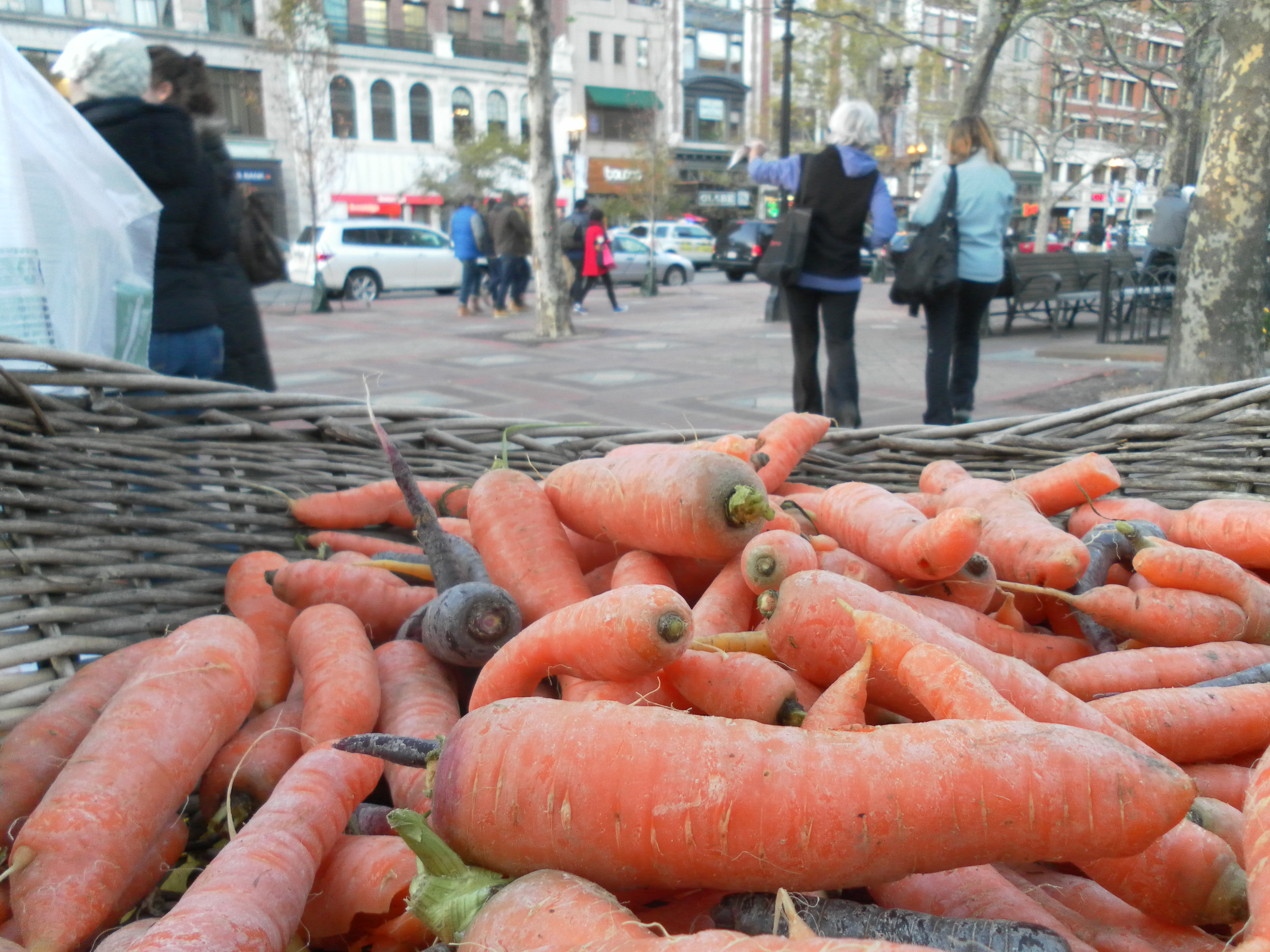
At an outdoor fall farmers market carrots grown at Sudbury’s Siena Farms are displayed in a bustling Copley Square.
Hammel says about three percent of the food people eat in Massachusetts comes from within the state. He wants to see that number increase by about 10 percent. He says he also hopes for about 50 percent of local consumers’ food to come from New England.
The Sustainable Business Network assists restaurants trying to use local products and holds All Local Dinners around the city where everything served has been grown and processed in New England. Hammel says their goal is not only to show the benefits of eating local but to make it possible.
One of the objectives of the festival is to bring together people who share this interest.
“There are all these examples of people making connections to develop a strong local food system,” he says.
This year’s festival included restaurants and local food providers from around the city and New England.
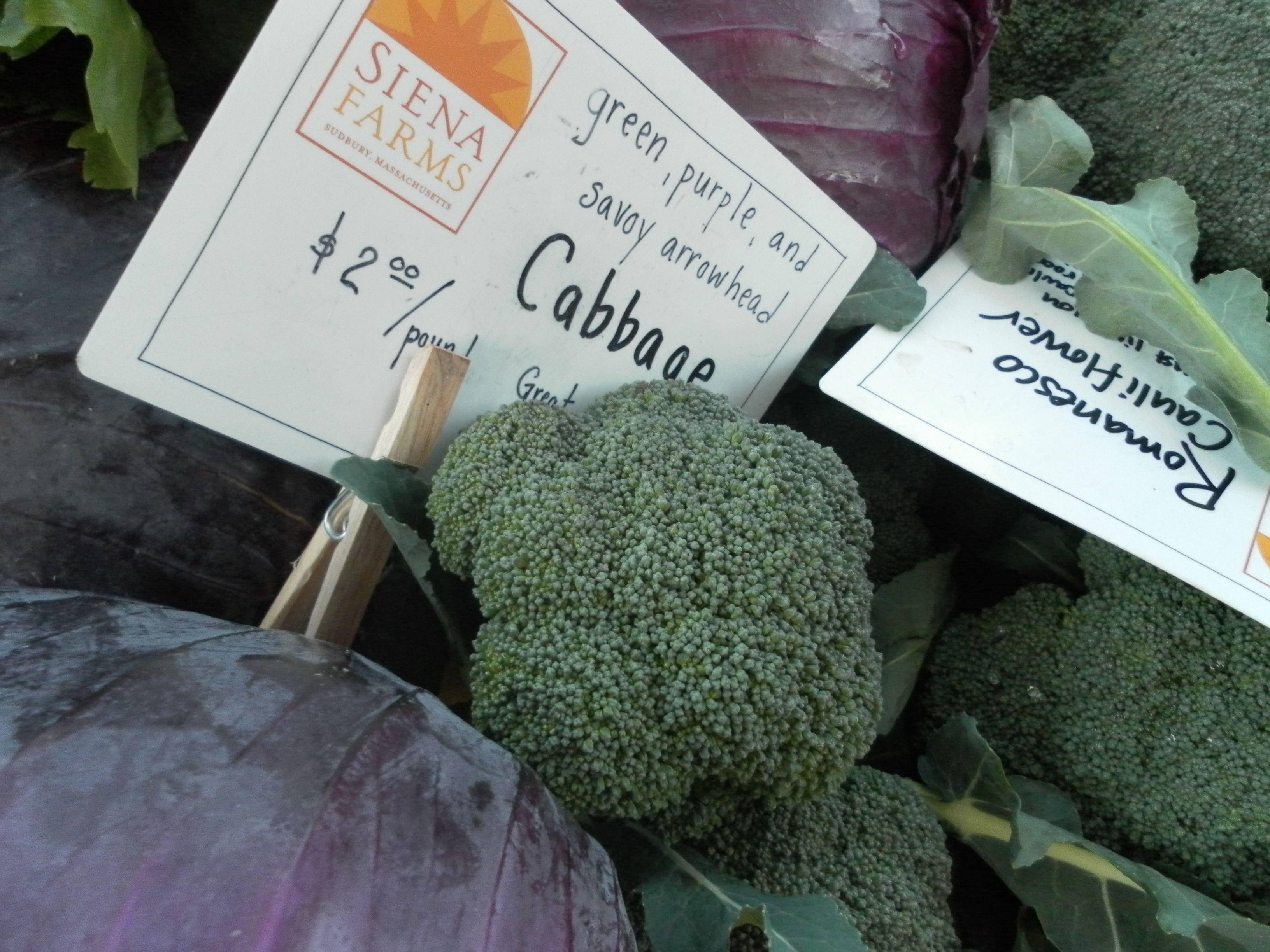
One of these businesses is Cambridge’s Sofra Bakery. They work with Siena Farms in Sudbury, Mass. to use local ingredients.
Siena is a relatively small farm, only about 60 acres, but they have a large presence in Boston.
“If people want to get a closer relationship to where their food comes from, it’s important to have smaller stores,” says Trevor Sieck, the marketing director for Siena Farms. “They’re not as alienated from where their food comes from.”
This is Sieck’s seventh year with Siena Farms. He’s had different jobs on the farm, describing its growth as a group effort. Now he spends most of his time at the Copley Square farmers market or at their store in the South End which opened last year.
He says the store gives Sienna Farms a place to sell year round without having to worry about the unreliable conditions they can face at the outdoor farmers market.
It has also given them a permanent location in a neighborhood with a 95 percent occupancy rate according to 2010 report by the Boston Redevelopment Authority.
“We try to have a personal relationship with most of the people that come in here,” Sieck says. “It’s hard not to.”
The store is tiny. This time of year radishes, apples and pumpkins are among the produce lining the walls of the cramped space. This doesn’t stop customers from collecting inside where most give a friendly, knowing wave to the manager and ask about the size of this or the color of that.
“We’ve been selling vegetables in Boston long enough that they trust us to fill them in –what’s tasting good and why,” Sieck says.
Many farms like Siena bring in revenue through Community Supported Agriculture, a nationally recognized program that, to put it simply, allows local foodies to subscribe to locally grown food.
Programs range from weekly to seasonal. Customers pay a flat rate for boxes of whatever is being harvested at the time.
Siena Farms boxes are distributed right outside the store, stacked and waiting for pickup on the sidewalk. With a wave to Sieck neighborhood customers stop by for fall produce.
Sieck says the majority of the farm’s business comes from Community Supported Agriculture, about 50 percent.
He says this is all part of the relationship between producer and consumer that comes with being a small farm.
“It’s really important for a store like us because we ask for people to support us,” he said. “They understand we’re a farm first and a store second.”
Sieck says that this communication is necessary for their small business to thrive.
“Sustainability for most small farms means relying on your community.”
Both gardeners and small farms have found a place in the South End community, defining what urban agriculture means to them.
Related Links:
Boston has nearly 30 farmers markets. The city’s site has a great interactive map which shows local farmers markets open based on specified dates.
*warning: this post might be hard to handle for some*
It has taking me all day to sit down and begin writing. To be honest, this morning was tough.
To begin, I’ll take a moment to explain what the chicken situation is like here at Leighton. Charlie and Lynn raise the typical double breasted chickens you would find at any supermarket with two exceptions: they are brought up organically and tend to average about eight/nine pounds. As this is a homestead and not a large industrial farm, they only process enough chickens for themselves throughout the year and to sell locally, covering the cost of feed and other expenses.
The chickens are first brought onto the farm as chicks. Some will die due to the sickly nature of the species. As Charlie explained to me yesterday the birds raised for harvest in our country today are a hybrid developed for optimal meat density. They’re weak, not built for survival.
At this point their chests have swelled to such an extreme that some can hardly walk. In other words, it’s time to make some sacrifices.
Charlie and Lynn have found that is much easier and less expensive to process the chickens on site. The more than sixty chickens they’ve raised are processed in small groups. Today we did about half. Thursday morning we will probably finish. Everything is done and set to cool before 11:00 which allows us to work outside.
The first step is of course the killing itself. Charlie handles this part. The chickens are carried one at a time over to a metal cone where they are placed neck down. Their necks are split here and the blood drains down plastic tarp and into buckets below. The chicken dies quickly but is kept in place by the cone as its lower body experiences involuntary muscle spasms (the “death throws”).
The body is then submerged in a hot water bath to liquefy the fat around the feathers before being placed in an upright dryer-like machine which pulls them all away.
At this point the chicken is placed in front of me -armed with pruning shears and knives next to Rebecca, my fellow WWOOFer and Lynn, today’s expert chicken gut-er.
My job quickly became simple to do well while remaining difficult to stomach. Replaying it now, however, I realize it sounds worse than it actually was.
Basically, I made the chicken look less like an animal and more like the plastic-wrapped, neatly trimmed cut of meat sitting next to the turkey and bacon. All it took was for me to clip off the head and legs (collected in the bucket at our feet).
When I became more comfortable with that, Lynn showed me how to begin prying lose the lungs and windpipe. On the final chickens I even got up close and personal with the abdominal organs -wrist deep to where I could tug membrane away from skin. I tried to let my curiosity dominate my other emotions, but overall, I’d have to say I was surprised.
Going into this experience I thought I might be able to go numb after awhile, performing the same task with each bird. But I found that my feelings were quite the opposite. Every chicken I came across was different. I couldn’t depend on them being positioned the same way or having their lungs in the same place. The fact is that as I helped to create a meat-like appearance the mortality of the chicken became more real. I have a better understanding of how and why butchering an animal can be a cultural experience -of how certain communities can be overwhelmed with respect for the animals they depend on for food.
You should know at this point that I have been a vegan for the past year. I broke my diet in anticipation for my stay at the farm. I have to say that having taken part in this process hasn’t necessarily scared me into going back to veganism, nor has it given me any assurance that I should again start eating meat. Rather, this conversion of death into a resource has affirmed much of what vegetarianism has taught me about diet, nourishment and the way I can choose to live my life.
Lynn and Charlie both explained that they first began raising livestock because they wanted the control and knowledge that comes with seeing their food mature from start to finish.
As we killed the chickens, it didn’t smell like blood, like a hospital or a morgue. It smelled like homemade chicken broth. And as my hosts keep telling me, the more you do this the more chicken smells like corn. I have only been here two days and already I have a heightened awareness of what I put into my body and where it comes from.
I couldn’t write this without thanking Charlie and Lynn for being so attentive to our feelings about todays chores. We were always given an out if our emotions or stomachs got the best of us. Interestingly enough, the physical and emotional toll wasn’t the highest. While everyone spent the day visibly exhausted and hardly talkative, it would be inaccurate to say we were merely drained. There was something more occupying our minds.
I think Lynn put it best as we gathered for lunch. It’s hard work and emotionally difficult at times, but the worst part isn’t that. It’s the “responsibility that comes with it -the responsibility to do it right.”
You know that expression about the henhouse -the one you use when your mom and aunt won’t stop chatting about your second cousin’s new girlfriend or the neighbors’ estranged daughter?
Well, it’s completely accurate.
*anecdote assist*
Today I collected the eggs from the laying hens. As soon as I walked to the door they all flocked to the coup and started talking to me -or, more likely, about me. It sounds crazy, but I could tell by their cooing that they were sizing up the new girl -dancing around under my feet as they followed me from one nest to the next. One even flew up onto the ledge above the eggs, peeking into each compartment and taking inventory before turning her head to look at me, carefully surveying my every move…
But besides this initial loss of sanity, today was a perfect combination of hard, tiring work and periods of relaxation, whether alone or with our hosts.
Honestly though, I’m exhausted at this point. Which is why I will keep this short as I have to be up by 6:30 tomorrow.
Every few minutes I hear a chicken call from down the hill. One of the over thirty chickens which I will help to “harvest” first thing in the morning.
Yes, exactly what you think it means.


 Elizabeth Gillis
